
Dow Jones Industrial Average Explained: A Beginner’s Guide
If you’ve ever watched financial news or checked stock market updates, you’ve likely heard the phrase “The Dow is up today” or “The Dow fell 300 points.” But what exactly does that mean?

The Dow Jones Industrial Average Index, commonly called the Dow, is one of the most widely followed stock market indexes in the United States. For beginners, it can feel confusing—yet understanding the Dow is an essential first step to understanding how the U.S. stock market works.
This beginner-friendly guide explains the Dow Jones in simple terms, its history, how it works, why it matters, and how it compares to other U.S. market indexes.
What Is the Dow Jones Industrial Average?
The Dow Jones Industrial Average (DJIA) is a stock market index that tracks the performance of 30 large, publicly traded U.S. companies. These companies are considered leaders in their industries and represent the overall health of the American economy.
Unlike owning a stock, you cannot invest directly in the Dow. Instead, it serves as a benchmark—a way to measure how the broader market is performing.
Why Is It Called “Industrial”?
When the Dow was created in 1896, many of the companies were industrial manufacturers. While today’s Dow includes tech, healthcare, finance, and consumer brands, the original name stuck.
A Brief History of the Dow Jones
The Dow Jones Industrial Average was created by Charles Dow, co-founder of Dow Jones Industrial average Index & Company and The Wall Street Journal.
Key Historical Milestones
- 1896: The Dow launched with 12 companies
- 1928: Expanded to 30 companies (still true today)
- 1987: Survived “Black Monday,” a historic market crash
- 2008: Played a central role during the financial crisis
- 2020: Experienced extreme volatility during the COVID-19 pandemic
For more than a century, the Dow has reflected America’s economic ups and downs.
How the Dow Jones Industrial Average Index Works
Price-Weighted Index Explained
The Dow is a price-weighted index, which means:
- Companies with higher stock prices have more influence
- Market value (company size) does not determine weight
This is different from many modern indexes.
The Dow Divisor
To account for stock splits and corporate actions, the Dow uses a special number called the Dow Divisor. This ensures the index remains consistent even when stock prices change due to technical reasons.
Companies in the Dow Jones
The Dow includes 30 blue-chip U.S. companies chosen by editors of The Wall Street Journal. These companies are leaders in their industries and have strong reputations.
Examples of Dow Companies
- Apple
- Microsoft
- Coca-Cola
- Johnson & Johnson
- Boeing
- McDonald’s
Companies can be added or removed over time to reflect changes in the U.S. economy.
Why the Dow Jones Matters to Investors
1. Market Sentiment Indicator
When the Dow rises or falls sharply, it often reflects how investors feel about:
- Economic growth
- Inflation
- Interest rates
- Corporate earnings
2. Media & Public Attention
The Dow is the most frequently quoted index in:
- TV news
- Newspapers
- Financial websites
Because of its visibility, it can influence public confidence.
3. Benchmark for Performance
Many investors compare their portfolio performance to the Dow to see how well they’re doing.
Dow Jones Industrial Average Index vs Other U.S. Stock Indexes
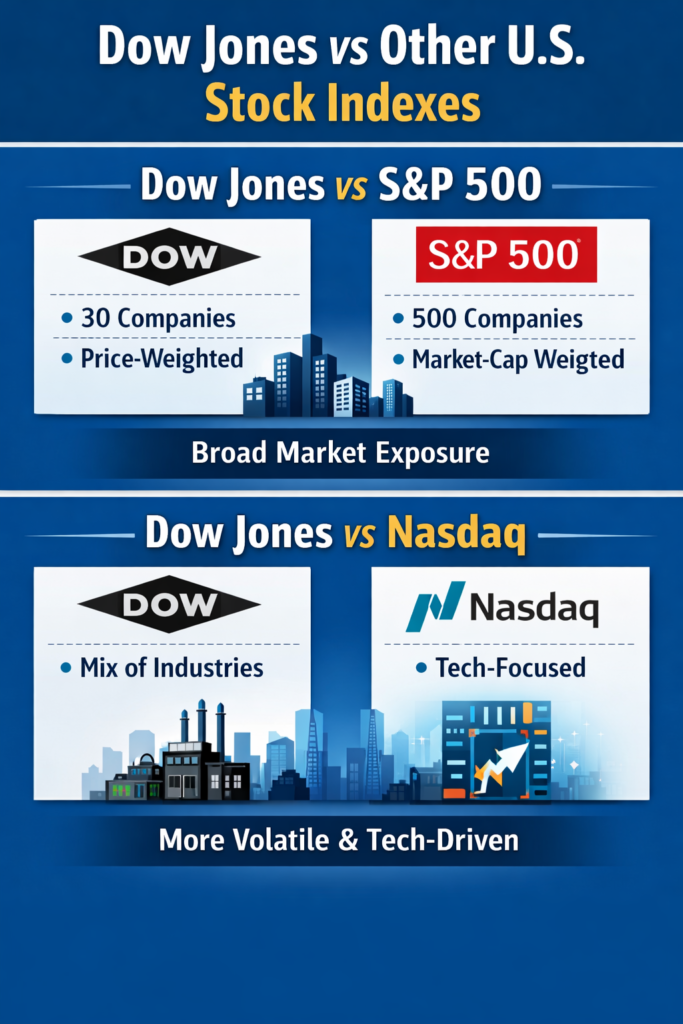
Understanding the Dow becomes easier when you compare it with other major indexes.
Dow Jones vs S&P 500
- Dow: 30 companies, price-weighted
- S&P 500: 500 companies, market-cap weighted
The S&P 500 offers broader market exposure.
Dow Jones vs Nasdaq
- Dow: Mix of industries
- Nasdaq Composite: Heavy focus on technology
The Nasdaq is more volatile and tech-driven.
How the Dow Reflects the U.S. Economy
The Dow often moves based on:
- Federal Reserve interest rate decisions
- Inflation data
- Employment reports
- Corporate earnings
While it doesn’t represent the entire economy, it provides a snapshot of corporate America.
Can You Invest in the Dow Jones Industrial Average Index?
You can’t buy the Dow itself, but you can invest through:
Dow Jones ETFs
- Track the Dow’s performance
- Trade like a stock
- Lower fees than mutual funds
Index Funds
- Long-term investment option
- Ideal for retirement accounts
These options allow everyday investors to gain exposure to Dow companies.
Advantages of the Dow Jones Industrial Average Index
Simple and Easy to Understand
With only 30 stocks, it’s straightforward compared to larger indexes.
Focus on Established Companies
Dow companies are generally stable and profitable.
Long-Term Historical Data
Over 100 years of data makes it valuable for research and comparison.
Limitations of the Dow Jones Industrial Average Index
Limited Representation
30 companies don’t capture the full U.S. economy.
Price-Weighted Bias
Higher-priced stocks influence the index more—even if they’re smaller companies.
Less Tech Exposure
Compared to the Nasdaq, tech representation is limited.
Dow Jones and Long-Term Investing
Historically, the Dow has shown an upward trend over the long term, despite short-term volatility.
What This Means for Beginners
- Market drops are normal
- Long-term investing reduces risk
- Patience matters more than timing
The Dow demonstrates how staying invested over time can build wealth.
Common Myths About the Dow Jones
“The Dow Represents the Entire Market”
False. It’s only a small slice.
“A Big Point Drop Means the Economy Is Collapsing”
Not always. Daily swings are normal.
“Only Experts Should Follow the Dow”
Anyone can learn and benefit from understanding it.
How Beginners Should Use the Dow Jones Industrial Average Index
Practical Tips
- Use it as a general market indicator
- Don’t base all decisions on daily movements
- Combine Dow insights with broader indexes
Understanding the Dow helps you become a more informed investor, not a reactive one.
The Dow Jones in Today’s Market
In today’s digital and global economy, the Dow still matters—but it works best when viewed alongside:
- The S&P 500
- The Nasdaq
- Economic data
Together, they provide a fuller picture of U.S. market health.
Final Thoughts: Is the Dow Still Relevant?
Yes—especially for beginners.
While it’s not perfect, the Dow Jones Industrial Average remains:
- A trusted market benchmark
- A symbol of U.S. economic strength
- A valuable educational tool
If you’re just starting your investing journey, learning the Dow is like learning the ABCs of the U.S. stock market.