What Is Herd Mentality in the Stock Market? Meaning & Examples
Financial markets are often portrayed as rational systems where investors carefully analyze data before making decisions. In reality, emotions and social behavior play a huge role. One of the most powerful psychological forces influencing market movements is herd mentality.
For beginner investors, understanding herd mentality is critical. It explains why people often buy at market highs, sell during crashes, and repeat the same mistakes generation after generation. By recognizing herd behavior, you can avoid emotional decisions and invest more thoughtfully.
What Is Herd Mentality in the Stock Market?
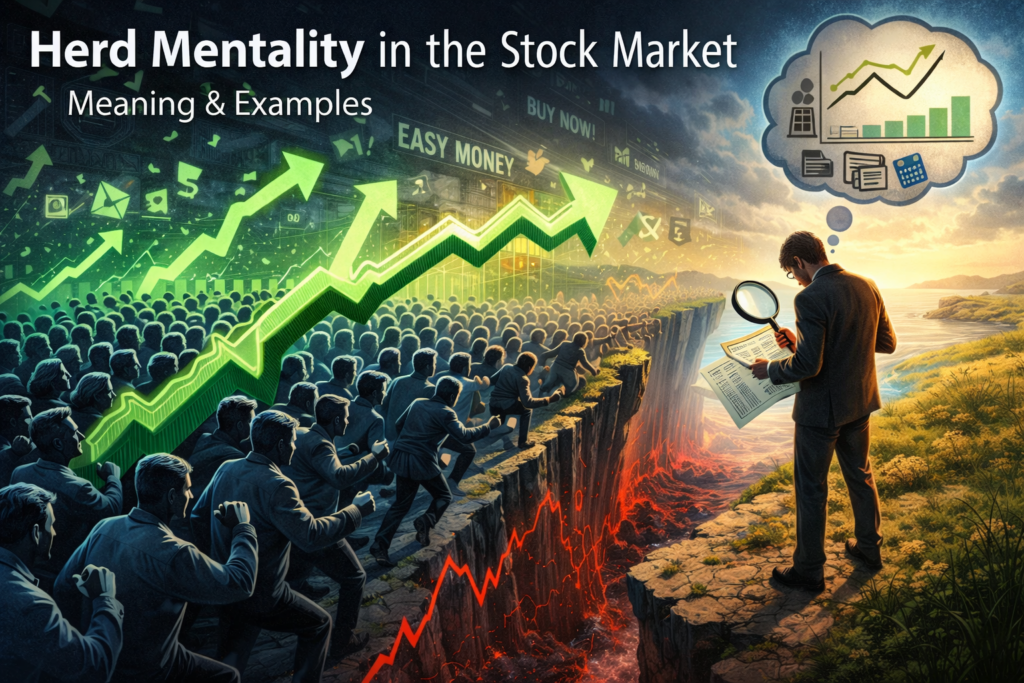
Herd mentality in the stock market refers to the tendency of investors to follow the actions of the crowd rather than make independent, rational decisions. Instead of relying on personal analysis, investors assume that if many others are buying or selling, it must be the right move.
In simple terms:
- When everyone is buying, people feel compelled to buy
- When everyone is selling, people feel compelled to sell
This behavior often causes prices to rise or fall much more than fundamentals justify.
Why Herd Mentality Happens
Herd mentality is deeply rooted in human psychology. Long before financial markets existed, humans survived by following groups. Acting alone often meant higher risk, while staying with the group felt safer.
In investing, this instinct shows up as:
- Desire for social validation
- Fear of being wrong alone
- Comfort in shared decisions
When large groups of investors move in the same direction, it reinforces confidence—until reality catches up.
The Role of Fear and Greed
Herd mentality is closely tied to two powerful emotions:
Greed During Rising Markets
When prices rise:
- Investors see others making money
- Media highlights success stories
- Confidence spreads
This creates a buying frenzy where people jump in without fully understanding what they’re buying.
Fear During Falling Markets
When prices fall:
- Losses dominate attention
- Negative headlines spread quickly
- Panic replaces logic
Investors rush to sell simply because others are selling, often locking in losses.
Herd Mentality vs Rational Investing
Rational investing is based on:
- Fundamentals
- Valuation
- Risk management
- Long-term goals
Herd mentality is based on:
- Popular opinion
- Price momentum
- Emotions
- Short-term reactions
The two often conflict. Markets tend to overshoot in both directions when herd behavior dominates.
A Simple Herd Mentality Example
Imagine a stock that trades at $30.
- A few positive news stories appear
- Early investors buy
- The price rises to $40
More investors notice the rise and assume something good must be happening. Without researching fundamentals, they buy too. The stock rises to $60.
Eventually:
- Growth slows
- Expectations become unrealistic
- Bad news appears
The stock drops quickly as investors panic and sell—often at prices below where the rally started.
This pattern is classic herd behavior.
Herd Mentality in Market Bubbles
Market bubbles are extreme examples of herd mentality.
During a bubble:
- Prices rise rapidly
- Everyone talks about easy profits
- Risk is ignored
- Skeptics are dismissed
Many investors enter late because they fear missing out. When reality sets in, the bubble bursts, and losses spread quickly.
Bubbles are not created by lack of intelligence—they are created by collective emotion.
Herd Mentality in Market Crashes
Herd behavior is just as powerful during downturns.
During market crashes:
- Fear spreads faster than facts
- Selling accelerates
- Rational thinking disappears
Even investors with long-term plans may sell simply because others are selling. This is why markets often fall faster than fundamentals justify.
The Fear of Missing Out (FOMO)
FOMO is one of the strongest drivers of herd mentality.
Investors feel:
- “Everyone else is making money”
- “If I don’t act now, I’ll miss my chance”
This pressure leads to impulsive decisions, often near market tops. FOMO pushes investors into trades they would normally avoid.
Social Media and Herd Mentality
Modern technology has amplified herd behavior.
- News spreads instantly
- Opinions go viral
- Success stories are highly visible
Social media platforms can magnify excitement or panic, making herd mentality stronger and faster than in the past.
Why Herd Mentality Is Dangerous for Beginners
New investors are especially vulnerable because they:
- Lack experience with market cycles
- Trust popular opinion
- React emotionally to price movements
- Feel pressure to act quickly
Without a clear plan, it’s easy to confuse crowd confidence with genuine opportunity.
Herd Mentality and Long-Term Performance
Ironically, herd behavior often leads to poor long-term results.
- Investors buy after prices have already risen
- Investors sell after prices have already fallen
This “buy high, sell low” pattern explains why many investors underperform the market over time.
A Realistic Beginner Scenario
Consider an investor named Lisa.
- She hears friends talking about a hot stock
- News headlines are positive
- The stock has already doubled
Lisa buys because she doesn’t want to miss out.
A few months later:
- The stock drops sharply
- Fear spreads
- Lisa sells at a loss
Lisa didn’t fail due to lack of intelligence—she followed the herd instead of a plan.
Herd Mentality vs Market Fundamentals
Herd mentality focuses on:
- What others are doing
- Short-term price movement
Fundamentals focus on:
- Earnings
- Cash flow
- Business health
Short-term prices are often driven by herd behavior, while long-term prices tend to reflect fundamentals.
Can Herd Mentality Ever Be Helpful?
Herd behavior is not always wrong. Sometimes:
- The crowd reacts quickly to real information
- Momentum reflects genuine improvement
The problem arises when investors follow the herd without understanding why.
How Experienced Investors Handle Herd Mentality
Successful investors don’t try to predict crowd behavior perfectly. Instead, they manage their response to it.
They:
- Stay calm during panic
- Avoid hype during euphoria
- Focus on long-term value
- Use volatility as information, not instruction
This emotional discipline sets them apart.
How to Avoid Herd Mentality as a Beginner
You can reduce the impact of herd behavior by following simple principles:
1. Have a Clear Plan
A defined investment strategy reduces emotional reactions.
2. Focus on Long-Term Goals
Short-term price movements matter less over time.
3. Do Your Own Research
Understand what you own and why you own it.
4. Limit Market Noise
Constant news and social media increase emotional pressure.
5. Diversify
Diversification reduces stress and panic during volatility.
Herd Mentality and Behavioral Finance
Behavioral finance studies how psychological biases affect financial decisions. Herd mentality is one of the most studied biases because of its consistent impact on markets.
Key insights include:
- Investors are predictably influenced by crowds
- Emotional reactions repeat across generations
- Awareness improves decision-making
Understanding herd behavior helps investors recognize emotional traps before falling into them.
Why Herd Mentality Keeps Repeating
Despite better access to information, herd mentality persists because:
- Humans are social by nature
- Emotions override logic under pressure
- Financial stakes intensify feelings
Technology changes, but psychology stays the same.
Turning Herd Mentality Into an Advantage
You don’t need to fight the crowd aggressively. Often, simply not following it blindly is enough.
Opportunities often appear when:
- Others are panicking
- Prices reflect fear rather than value
Staying patient and disciplined allows you to act rationally while others react emotionally.
Final Thoughts
Herd mentality in the stock market is the tendency of investors to follow the crowd rather than rely on independent analysis. Driven by fear, greed, and social influence, herd behavior can push prices far above or below their true value.
For beginner investors, recognizing herd mentality is a powerful skill. While you can’t control how others behave, you can control your own decisions. By understanding why herd behavior happens and learning to manage emotional pressure, you give yourself a significant advantage in navigating financial markets.
In the long run, successful investing is less about following the crowd—and more about thinking clearly when the crowd loses its way.
Related Posts
Emotional Cycles of the Stock Market Explained Step by Step
The stock market is not driven by numbers alone. It…
Anchoring Bias in Investing: Why First Prices Affect Decisions
Anchoring bias is one of the most common—and most damaging—psychological…
Fear and Greed Index Explained: How Emotions Control the Market
Fear and Greed Index Explained: How Emotions Control the Market…
2 Replies to “What Is Herd Mentality in the Stock Market? Meaning & Examples”