If you’ve ever felt the urge to invest in a stock simply because everyone else seems to be making money, you’ve experienced FOMO. In investing, FOMO (Fear of Missing Out) is one of the most common—and costly—psychological traps investors fall into.
FOMO doesn’t just affect beginners. Even experienced investors can be pulled into emotional decisions when markets are rising fast and success stories dominate the news. Understanding FOMO is critical because it explains why people often buy at market highs, chase hype-driven stocks, and abandon well-thought-out plans.
What Is FOMO in Investing?
FOMO in investing is the emotional anxiety investors feel when they believe others are profiting from an opportunity they are not part of. This fear creates urgency and pressure to act quickly—often without proper research or risk assessment.
In simple terms, FOMO sounds like:
- “Everyone else is making money—why am I not?”
- “If I don’t buy now, I’ll miss the chance.”
- “This stock keeps going up, so it must be safe.”
Instead of making decisions based on fundamentals or strategy, investors driven by FOMO act based on emotion and social comparison.
Why FOMO Is So Powerful
FOMO is rooted in human psychology. People are naturally social and compare themselves to others. When money is involved, those comparisons become emotionally intense.
FOMO is powerful because it combines:
- Greed (desire for profits)
- Fear (fear of being left behind)
- Social pressure (seeing others succeed)
In markets, these emotions can override logic very quickly—especially during strong rallies.
How FOMO Shows Up in the Stock Market
FOMO appears most clearly during periods of rapid price increases.
Common signs include:
- Buying stocks after large price jumps
- Investing without understanding the business
- Ignoring valuation or risk
- Increasing position sizes impulsively
When prices rise fast, the emotional pain of not participating often feels worse than the fear of losing money.
The Role of Social Media and News
Modern investing culture has amplified FOMO significantly.
- Social media highlights wins, not losses
- Headlines focus on dramatic success stories
- Influencers showcase profits without context
This creates the illusion that “everyone is winning,” even though many investors are quietly losing money. Constant exposure to these messages increases pressure to act quickly.
A Simple FOMO Investing Example
Imagine a stock trading at $20.
- Positive news appears
- Early investors buy
- The price rises to $40
Now:
- Social media buzz increases
- Friends talk about quick profits
- Headlines mention “the next big opportunity”
An investor driven by FOMO buys at $45, believing the price will keep rising. Shortly after, enthusiasm fades, and the stock falls back to $30.
The loss wasn’t caused by lack of intelligence—it was caused by emotional timing.
Why FOMO Leads to Buying at Market Tops
FOMO is strongest when prices are already high.
That’s because:
- Rising prices create confidence
- Past gains feel like proof
- Risk feels invisible
Ironically, the moment most people feel safest buying is often when risk is highest. FOMO pushes investors to enter trades late, after much of the upside is already gone.
FOMO vs Long-Term Investing
Long-term investing focuses on:
- Business fundamentals
- Valuation
- Risk management
- Time in the market
FOMO focuses on:
- Short-term price movement
- What others are doing
- Emotional urgency
These approaches are fundamentally incompatible. FOMO-driven decisions usually conflict with long-term success.
Why Beginners Are Especially Vulnerable
New investors are more likely to fall victim to FOMO because they:
- Lack experience with market cycles
- Overestimate short-term trends
- Feel pressure to “catch up”
- Haven’t experienced market downturns
Without past losses to create caution, beginners may mistake excitement for opportunity.
The Emotional Cost of FOMO
Beyond financial losses, FOMO has emotional consequences:
- Stress and anxiety
- Regret after losses
- Loss of confidence
- Abandoning investing altogether
Repeated FOMO mistakes can damage both portfolios and mindset.
FOMO and Herd Mentality
FOMO is closely related to herd mentality—the tendency to follow the crowd.
When many investors buy at once:
- Prices rise
- Confidence spreads
- More people join
This feedback loop fuels bubbles. Eventually, reality interrupts expectations, and prices fall quickly.
Why FOMO Rarely Works Long Term
FOMO investing rarely succeeds because:
- It ignores risk
- It reacts late to trends
- It lacks an exit plan
- It relies on emotion, not strategy
Even if a FOMO-driven trade works once, it encourages repeat behavior that often leads to larger losses later.
A Realistic Beginner Scenario
Consider an investor named Ryan.
- Ryan avoids investing early in a rally
- Months later, markets keep rising
- Friends talk about profits
- Ryan feels left behind
He invests aggressively near the top. Soon after, markets correct sharply. Ryan panics, sells at a loss, and feels regret.
Ryan didn’t fail because markets are unfair—he failed because emotion replaced discipline.
FOMO vs Fundamentals
Fundamentals answer:
- Is the company profitable?
- Is growth sustainable?
- Is the valuation reasonable?
FOMO ignores these questions entirely. It focuses on:
- Recent performance
- Popular opinion
- Emotional urgency
Short-term prices reflect emotion, but long-term prices reflect fundamentals.
Can FOMO Ever Be Useful?
FOMO itself is not useful—but awareness of it is.
Recognizing FOMO can:
- Signal emotional extremes
- Warn of overheated markets
- Encourage caution
Many experienced investors see widespread FOMO as a reason to slow down, not speed up.
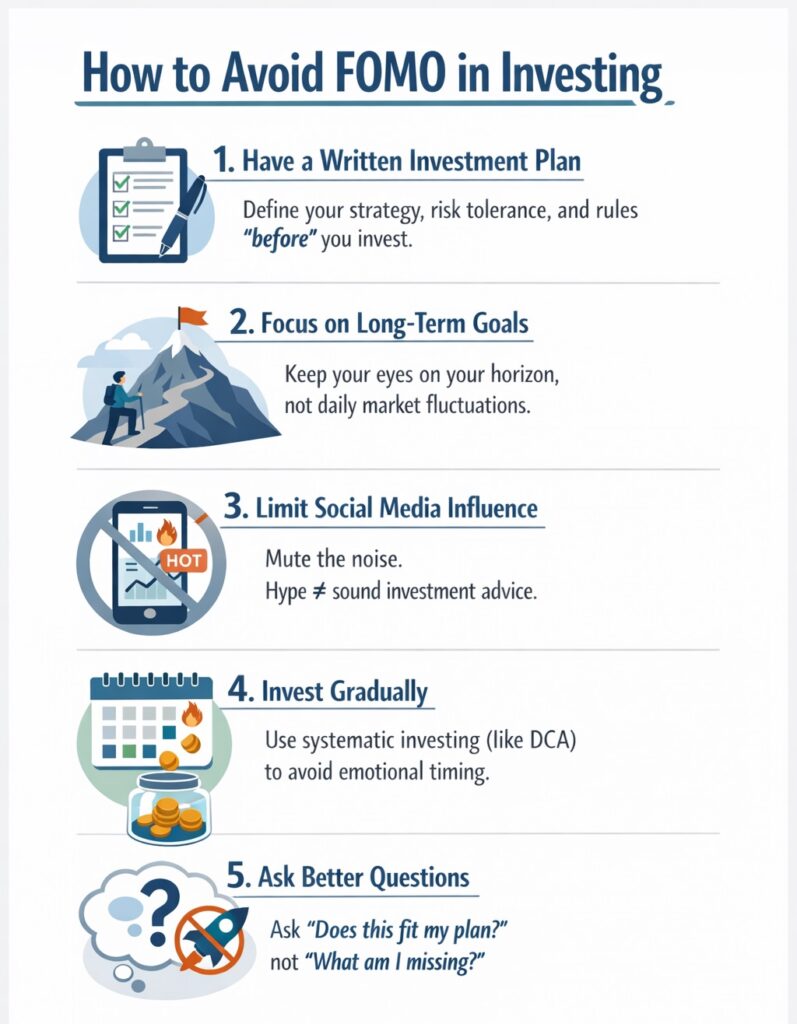
How to Avoid FOMO in Investing
You can’t eliminate FOMO, but you can manage it.
1. Have a Written Investment Plan
Clear rules reduce emotional decisions.
2. Focus on Long-Term Goals
Short-term hype matters less over years.
3. Limit Social Media Influence
Constant comparison increases emotional pressure.
4. Invest Gradually
Regular investing reduces timing mistakes.
5. Ask Better Questions
Instead of “What’s going up?” ask:
- “Why is it going up?”
- “What could go wrong?”
Using FOMO as a Warning Signal
When you feel intense urgency to buy, pause. Strong emotional pressure is often a sign that:
- Risk is being underestimated
- Expectations are unrealistic
Emotions are data. FOMO often signals that markets may be overheated.
FOMO and Market Cycles
FOMO appears repeatedly at:
- Late-stage bull markets
- During bubbles
- Around hype-driven assets
Understanding this pattern helps investors avoid repeating historical mistakes.
Why Discipline Beats FOMO
Successful investors are not emotionless—they are disciplined.
They:
- Accept missing some opportunities
- Avoid chasing hype
- Focus on consistent strategies
Missing out on one rally is far less damaging than making repeated emotional mistakes.
FOMO vs Patience
Patience feels uncomfortable when others are winning. But patience is often rewarded over time.
Markets always offer new opportunities. FOMO convinces investors that this one moment is their only chance—when it rarely is.
Final Thoughts
FOMO in investing is the fear of missing out on profits when others appear to be succeeding. Driven by greed, fear, and social pressure, FOMO often leads investors to buy at market highs, ignore risk, and abandon sound strategies.
For beginner investors, understanding FOMO is essential. You can’t control market hype, social media, or crowd behavior—but you can control your response. By recognizing FOMO when it appears and choosing discipline over urgency, you protect both your money and your mindset.
In investing, the goal isn’t to catch every opportunity. It’s to make consistent, rational decisions over time. Learning to manage FOMO is one of the most important steps toward long-term investing success.
Frequently Asked Questions About FOMO in Investing
What is FOMO in investing?
FOMO in investing, or Fear of Missing Out, is the emotional pressure investors feel when they believe others are making money from opportunities they are not part of. This fear often leads to rushed decisions, buying at high prices, and investing without proper research or risk assessment.
Why does FOMO cause bad investing decisions?
FOMO causes bad investing decisions because it replaces logical analysis with emotional urgency. When markets are rising and success stories dominate headlines and social media, investors feel pressured to chase trends, ignore risk, and abandon disciplined long-term strategies.
How does FOMO affect stock market performance?
FOMO can negatively affect stock market performance by encouraging investors to buy after large price increases, take oversized positions, and focus on hype rather than fundamentals. Over time, this behavior can reduce returns and increase volatility.
Who is most vulnerable to FOMO in investing?
Beginner investors are especially vulnerable to FOMO because they lack experience with market cycles and may feel pressure to catch up with others. However, even experienced investors can fall victim to FOMO during strong bull markets or hype-driven rallies.
How can investors avoid FOMO in the stock market?
Investors can reduce FOMO by following a written investment plan, focusing on long-term goals, investing gradually over time, limiting social media influence, and evaluating investments based on fundamentals rather than short-term price movements.
5 Replies to “FOMO in Investing: Why Fear of Missing Out Causes Bad Decisions”