
If you’re learning how to analyze stocks or understand business performance, one word shows up everywhere: revenue.
You’ll see revenue mentioned in earnings reports, financial news headlines, and company investor presentations. It’s often the first big number people look at when judging whether a company is growing or struggling.
In simple terms:
Revenue is the total amount of money a company brings in from sales during a specific period of time.
Revenue is sometimes called sales, total sales, or the top line—because it appears near the top of a company’s income statement.
In this beginner-friendly guide, we’ll explain what revenue really means, how it’s calculated, how it differs from profit, and how investors use revenue to evaluate U.S. companies.
Revenue is the total income a company earns from selling its products or services.
What Is Revenue?
This includes money a business collects from customers when it provides things like:
- physical products (clothing, food, electronics)
- digital services (subscriptions, apps, software)
- professional services (insurance, consulting, healthcare services)
- advertising and licensing (media and platforms)
Revenue Definition
Revenue is the total amount of sales a company makes before subtracting expenses.
That “before subtracting expenses” part is extremely important because revenue is not the same thing as profit.
Why Revenue Is Called the “Top Line”
Revenue is often called the top line because it’s usually listed at the very top of a company’s income statement.
It represents the starting point for calculating profitability:
Revenue
− Costs and expenses
= Profit (or loss)
So when investors say:
“This company has strong top-line growth”
They mean the company’s sales are increasing.
Revenue vs. Profit: What’s the Difference?
One of the biggest beginner mistakes is thinking revenue equals profit. It doesn’t.
Revenue
✅ Total sales generated
❌ Does not account for costs
Profit (Net Income)
✅ What’s left after expenses
✅ Includes costs like wages, rent, materials, marketing, taxes
✅ Shows how much the company actually earns
Simple Example
Imagine a small business:
- Revenue: $1,000,000 per year
- Expenses: $950,000 per year
Profit = $1,000,000 − $950,000 = $50,000
That business has high revenue but low profit.
On the other hand, another company might have:
- Revenue: $500,000
- Expenses: $300,000
Profit = $200,000
Lower revenue, but higher profit.
Revenue tells you how much is coming in. Profit tells you how much is kept.
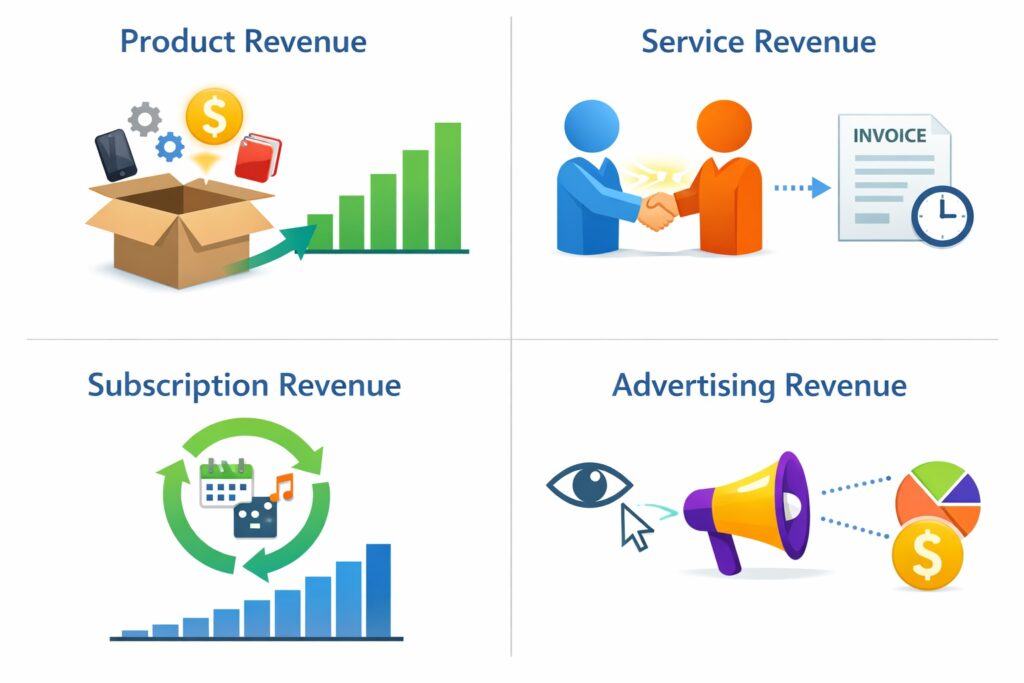
Types of Revenue (How Companies Earn Money)
Different businesses generate revenue in different ways. Understanding revenue streams can help investors evaluate a company more realistically.
1) Product Revenue
This is money made by selling physical goods.
Examples:
- a retail company selling clothing
- a consumer brand selling beverages
- an electronics company selling devices
2) Service Revenue
This is money earned by providing services.
Examples:
- credit card processing fees
- shipping and logistics services
- medical and healthcare services
3) Subscription Revenue
Subscription models are extremely common in the U.S. economy today.
Examples:
- streaming services
- software subscriptions
- membership-based products
Subscription revenue is often seen as attractive because it can be recurring and predictable.
4) Advertising Revenue
Many media and online platform businesses earn a major share of revenue through ads.
Examples:
- ads displayed in apps and websites
- sponsored content
- marketing placements
Advertising revenue can be powerful, but it may drop during economic slowdowns when companies cut marketing budgets.
Gross Revenue vs. Net Revenue (Important Difference)
Not all revenue is counted the same way.
Gross Revenue
Gross revenue is the total money collected before deductions like:
- refunds
- discounts
- returns
- commissions or allowances
Net Revenue
Net revenue is what the company keeps after subtracting those reductions.
Many companies report net revenue as their main revenue figure.
Beginner tip: When comparing two companies, make sure you’re comparing the same type of revenue measurement.
Revenue Example: How It Looks in Real U.S. Businesses
Let’s walk through realistic examples of how revenue works in different industries.
Example 1: A Retail Company
A retail chain sells:
- 2 million products in a quarter
- average price per product: $25
Revenue = 2,000,000 × $25 = $50 million
Simple and straightforward.
But that company still needs to pay for:
- inventory
- store rent
- wages
- shipping
- marketing
So high revenue doesn’t guarantee high profit.
Example 2: A Subscription Software Company
A U.S. software company charges:
- $20 per month per user
- 500,000 active subscribers
Monthly revenue = 500,000 × $20 = $10 million
Annual revenue = $10 million × 12 = $120 million
Investors often like subscription revenue because it can grow steadily, especially if the company retains customers.
Example 3: A Credit Card Company
A financial company might generate revenue through:
- transaction fees
- interest income (from balances)
- subscription-like card fees
Revenue can rise if:
- more people use the card
- consumers spend more
- interest income increases
But risks also rise if customers stop paying their debts.
Why Revenue Matters to Investors
Revenue is one of the best first clues about whether a business is growing.
Here’s why investors pay attention to it:
1) Revenue Shows Demand
If revenue is rising, it usually means more customers are buying.
That could be from:
- increased demand
- better marketing
- product expansion
- price increases
- gaining market share
2) Revenue Growth Can Drive Stock Prices
In the U.S. stock market, fast-growing revenue can attract investors—especially for growth companies.
Even if a company isn’t profitable yet, strong revenue growth may signal future potential.
This is common in industries like:
- technology
- software
- e-commerce
- biotech (in earlier stages)
3) Revenue Helps Compare Competitors
Revenue is often used to compare companies within the same industry.
Example:
- Company A earns $10 billion per year in revenue
- Company B earns $2 billion per year
Company A likely has more market reach, pricing power, and scale.
That doesn’t automatically make Company A a better investment—but it helps frame the comparison.
Revenue Growth: The Metric Investors Watch Closely
Revenue is important—but revenue growth is often even more important.
Investors pay close attention to:
- quarter-over-quarter (QoQ) revenue growth
- year-over-year (YoY) revenue growth
Example: Year-over-Year Growth
If a company reports:
- Revenue this quarter: $5 billion
- Revenue same quarter last year: $4 billion
YoY revenue growth = ($5B − $4B) / $4B = 25%
That’s strong growth, and it often draws investor interest.
Can Revenue Go Up for “Bad” Reasons?
Yes—and this is why investors don’t look at revenue alone.
Revenue can increase due to:
1) Price Increases (Not More Customers)
A company might earn more revenue because it raised prices—not because it attracted more buyers.
That could be a good sign (pricing power) or a warning sign (customers may leave later).
2) Buying Another Company
If a company acquires another business, revenue may rise quickly, but it might not reflect organic growth.
This is why investors often look for:
organic revenue growth (growth without acquisitions)
3) One-Time Events
Revenue may spike due to a temporary event like:
- short-term demand surge
- limited product launch
- unusual contract timing
Investors often want to know whether revenue is sustainable.
Revenue vs. Earnings: Why Both Matter
Revenue is “top line.” Earnings are part of the “bottom line.”
A healthy business generally shows:
✅ steady or growing revenue
✅ improving profit margins
✅ rising earnings over time
But not all companies follow that pattern.
Some companies have:
- strong revenue but weak profits (high costs)
- lower revenue but strong profits (high efficiency)
That’s why investors often look at revenue alongside:
Revenue on Financial Statements (Where to Find It)
Revenue is reported on a company’s income statement, usually as the first major line item.
You’ll see it labeled as:
- Revenue
- Total Revenue
- Net Sales
- Sales
- Net Revenue
Public U.S. companies report revenue in:
- quarterly earnings reports
- annual reports (10-K filings)
- investor presentations
Common Revenue Mistakes Beginners Make
Here are a few easy traps to avoid:
Mistake #1: Assuming High Revenue Means a Company Is Successful
Some companies have huge sales but tiny margins and high costs.
Revenue is a starting point—not the final verdict.
Mistake #2: Ignoring Revenue Trends
A single quarter doesn’t tell the full story. Look at revenue over time.
Is it growing steadily? Stagnating? Falling?
Mistake #3: Comparing Revenue Across Totally Different Industries
A grocery store chain might have massive revenue but low margins.
A software company might have lower revenue but high margins.
Industry context matters.
Key Takeaways: Revenue Meaning in Plain English
Revenue is the total sales a company generates during a period of time. It’s a key measure of business activity, customer demand, and growth—but it does not tell you whether the company is profitable.
Here’s the quick recap:
- Revenue = total money brought in from sales
- It’s also called sales or the top line
- Revenue is not profit—expenses come later
- Investors watch revenue growth (YoY and QoQ) closely
- Revenue helps compare company size and market demand
If you’re learning stock investing or business fundamentals, revenue is one of the best metrics to understand early. Once you grasp revenue, it becomes much easier to interpret earnings reports, company valuations, and the financial headlines you see every day.
Frequently Asked Questions About Revenue
What is revenue in business and investing?
Revenue is the total amount of money a company earns from selling its products or services during a specific period of time. It represents total sales before any expenses are deducted and is often referred to as the “top line” on a company’s income statement.
Is revenue the same as profit?
No. Revenue is the total sales a company generates, while profit is what remains after subtracting all expenses such as wages, rent, materials, marketing, and taxes. A company can have high revenue but low or negative profit.
Why do investors care about revenue?
Investors care about revenue because it shows customer demand and business growth. Increasing revenue can signal expanding market share and future profit potential, especially for growth companies in the U.S. stock market.
What are the different types of revenue?
Common types of revenue include product revenue from selling physical goods, service revenue from providing services, subscription revenue from recurring payments, and advertising revenue earned through marketing placements and media platforms.
What is revenue growth and why does it matter?
Revenue growth measures how much a company’s sales increase over time, usually on a year-over-year or quarter-over-quarter basis. Consistent revenue growth often attracts investors because it can lead to higher earnings and long-term stock price appreciation.
3 Replies to “Revenue: What It Means (Total Sales Generated by a Company) and Why It Matters”