
Behavioral finance is the study of how human psychology influences financial decisions and market outcomes. Traditional finance assumes investors are rational, unemotional, and always act in their best financial interest. Behavioral finance challenges that idea by showing that emotions, mental shortcuts, and biases often drive real-world investing behavior.
For beginners in U.S. stock markets, behavioral finance offers powerful insights. It explains why investors buy high and sell low, why bubbles and crashes occur, and why even smart, well-informed people make costly mistakes with money.
This guide breaks down behavioral finance in a clear, beginner-friendly way—using realistic U.S.-market examples to show how psychology affects investing and how you can make better decisions by understanding it.
What Is Behavioral Finance?
Behavioral finance combines insights from:
- Psychology
- Economics
- Finance
It studies how cognitive biases and emotional responses influence:
- Investment choices
- Risk perception
- Market prices
Instead of assuming investors are perfectly logical, behavioral finance recognizes a simple truth:
Markets are made of people—and people are emotional, imperfect, and influenced by fear and greed.
Why Behavioral Finance Matters
Behavioral finance matters because:
- Markets frequently deviate from “fair value”
- Investors consistently underperform market benchmarks
- Emotional mistakes repeat across generations
Understanding behavioral finance helps explain:
- Stock market bubbles
- Panic selling during crashes
- Overconfidence in bull markets
- Poor timing by individual investors
It doesn’t require complex math—just awareness of how the human mind works under uncertainty.
Traditional Finance vs. Behavioral Finance
Traditional Finance Assumptions
- Investors are rational
- Markets are efficient
- Prices reflect all available information
Behavioral Finance Reality
- Investors are emotional
- Markets overreact and underreact
- Prices reflect information plus psychology
Behavioral finance doesn’t reject traditional finance—it adds realism to it.
The Core Idea Behind Behavioral Finance
At its heart, behavioral finance says:
Investors rely on mental shortcuts and emotions to make decisions—especially under stress or uncertainty.
These shortcuts are useful in daily life, but in investing they often lead to systematic errors.
Common Behavioral Biases in Investing
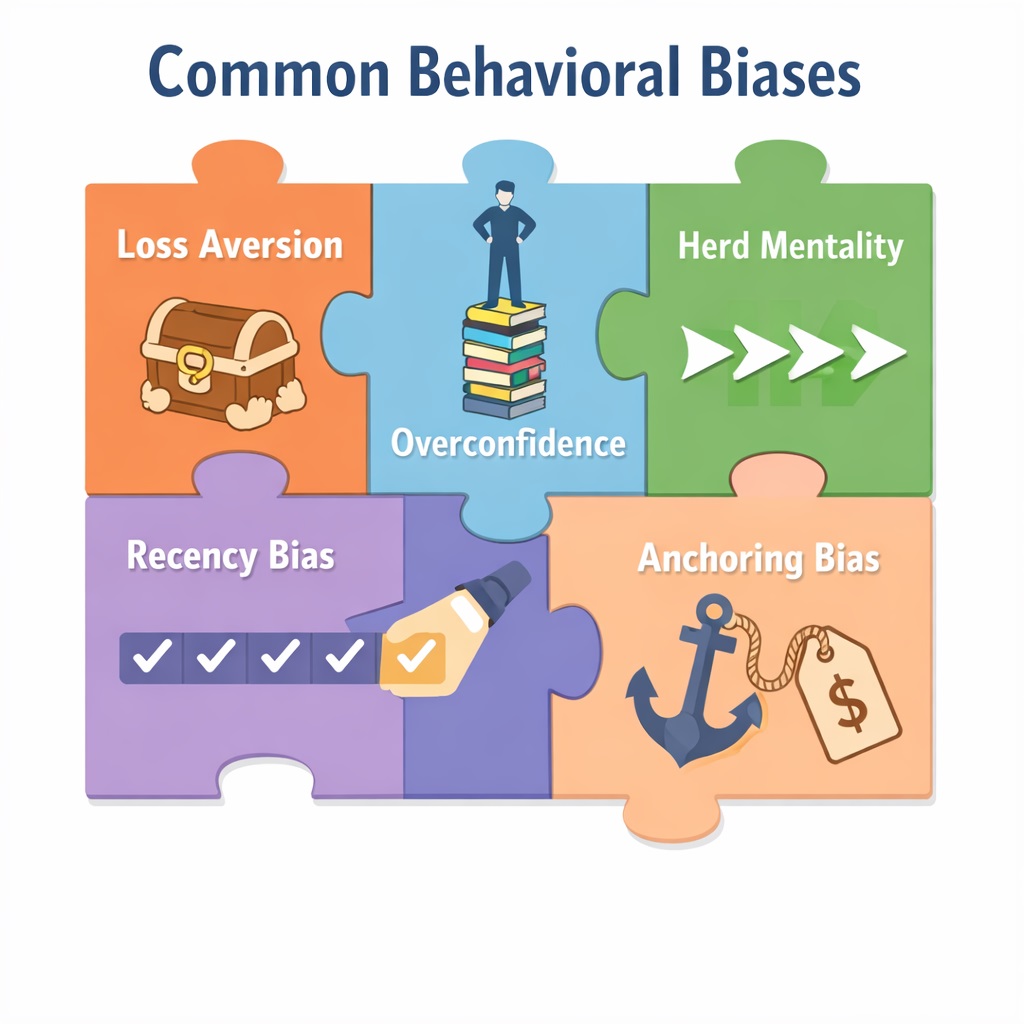
Behavioral finance identifies many recurring biases. Below are some of the most important ones beginners encounter.
1. Loss Aversion
Loss aversion means losses feel more painful than gains feel pleasurable.
Example:
- Losing $1,000 hurts more than gaining $1,000 feels good
In investing, loss aversion causes people to:
- Hold losing stocks too long
- Sell winners too early
- Avoid risk even when it’s reasonable
Loss aversion explains why many investors panic during downturns.
2. Overconfidence
Overconfidence leads investors to overestimate:
- Their knowledge
- Their skill
- Their ability to predict markets
During strong bull markets, investors may believe:
- “I’m good at this”
- “This stock can’t fail”
- “I don’t need diversification”
Overconfidence often increases risk-taking right before major losses.
3. Herd Mentality
Herd behavior occurs when investors follow the crowd instead of independent analysis.
Examples:
- Buying popular stocks because “everyone is”
- Selling during market panics because others are selling
Herding plays a major role in bubbles and crashes, especially in highly visible markets like the NASDAQ, where sentiment can shift rapidly.
4. Recency Bias
Recency bias causes investors to give too much weight to recent events.
Examples:
- Assuming recent market gains will continue indefinitely
- Believing recent losses mean more losses are coming
This bias explains why investors often:
- Buy near market tops
- Sell near market bottoms
Recent experiences feel more important than long-term history.
5. Anchoring Bias
Anchoring bias occurs when investors fixate on a specific number—such as:
- A purchase price
- A previous high
- A round number
Example:
- “I’ll sell once the stock gets back to $100”
The anchor influences decisions even if it’s no longer relevant.
Behavioral Finance and Market Bubbles
Behavioral finance helps explain why bubbles form.
A typical bubble follows this pattern:
- New opportunity or innovation appears
- Early gains attract attention
- Optimism turns into excitement
- Speculation replaces analysis
- Prices detach from fundamentals
- Reality sets in and prices collapse
Bubbles are driven less by data and more by human emotion and social reinforcement.
Behavioral Finance and Market Crashes
Crashes are the emotional mirror image of bubbles.
During crashes:
- Fear dominates logic
- Investors sell to avoid further pain
- Rational analysis disappears
This behavior is common during sharp selloffs on exchanges like the New York Stock Exchange, where panic selling can spread rapidly across sectors.
Why Beginners Are Especially Vulnerable
New investors are more prone to behavioral mistakes because:
- They lack experience across market cycles
- Emotions feel more intense
- Short-term outcomes feel personal
Early success can lead to overconfidence. Early losses can lead to excessive caution. Both are shaped by psychology rather than strategy.
Behavioral Finance in Everyday U.S. Investing
Behavioral biases show up in common situations such as:
- Selling during market volatility
- Chasing “hot” stocks after big gains
- Avoiding stocks after negative headlines
- Holding too much cash due to fear
These behaviors explain why many individual investors earn lower returns than the market itself.
Behavioral Finance vs. Smart Investing
Smart investing is not about eliminating emotion—it’s about managing it.
Emotion-Driven Investing
- Reactive
- Short-term focused
- Influenced by headlines
Behaviorally Aware Investing
- Planned
- Long-term focused
- Disciplined
Behavioral finance provides the framework for building better habits.
How Professionals Use Behavioral Finance
Professional investors and advisors:
- Design rules-based strategies
- Diversify to reduce emotional stress
- Use rebalancing to counter bias
- Expect emotional extremes
They don’t assume they’re immune to bias—they plan around it.
Practical Ways Beginners Can Apply Behavioral Finance
You don’t need advanced knowledge to benefit from behavioral finance.
1. Create a Written Plan
Define:
- Why you’re investing
- How much risk you can tolerate
- When you’ll rebalance
Plans reduce emotional decisions.
2. Focus on Long-Term Goals
Short-term price movement matters less than long-term progress.
3. Automate When Possible
Automatic investing and rebalancing reduce emotional interference.
4. Limit News Consumption
Too much financial news amplifies fear and excitement.
5. Expect Mistakes—and Learn From Them
Behavioral finance doesn’t promise perfection. It promotes awareness and improvement.
Behavioral Finance and Risk Management
Behavioral finance reinforces the importance of:
- Diversification
- Position sizing
- Avoiding excessive leverage
These tools protect investors not just from markets—but from their own emotions.
Can Behavioral Finance Beat the Market?
Behavioral finance is not a get-rich-quick strategy.
Its value lies in:
- Avoiding major mistakes
- Improving consistency
- Enhancing long-term outcomes
Avoiding big losses often matters more than finding big winners.
Regulation and Behavioral Finance
U.S. markets are overseen by the U.S. Securities and Exchange Commission (SEC), which ensures transparency and fairness. However, regulation cannot eliminate psychological bias.
Behavioral finance focuses on the one thing regulation can’t fix: human behavior.
A Simple Behavioral Finance Self-Check
Before making an investment decision, ask:
- Am I reacting emotionally?
- Am I following a plan—or a feeling?
- Would I make the same decision if markets were calm?
These questions bring awareness to bias.
Final Takeaway
Behavioral finance explains why investing is often harder than it looks. Markets are influenced not just by earnings and data, but by fear, greed, confidence, and social behavior. These psychological forces create opportunities—but also costly traps.
For beginners in U.S. stock markets, understanding behavioral finance is one of the most valuable skills you can develop. It helps you recognize emotional patterns, avoid common mistakes, and stay disciplined when markets test your confidence.
Successful investing is not about being emotionless.
It’s about being emotion-aware.
When you understand how psychology shapes markets—and your own decisions—you gain a powerful advantage that no chart or formula alone can provide.
Frequently Asked Questions About Behavioral Finance
What is behavioral finance?
Behavioral finance is the study of how psychology and emotions influence financial decisions. It explains why investors often act irrationally, such as buying high, selling low, or following the crowd instead of relying on logic and data.
Why is behavioral finance important for investors?
Behavioral finance is important because emotional biases like fear, greed, and overconfidence can lead to costly investing mistakes. Understanding these biases helps investors manage risk better and improve long-term decision-making.
What are common behavioral biases in investing?
Common behavioral biases include loss aversion, overconfidence, herd mentality, anchoring bias, and recency bias. These biases affect how investors interpret information and respond to market movements.
How does behavioral finance explain market bubbles and crashes?
Behavioral finance explains bubbles and crashes as the result of collective emotional behavior. Greed and herd mentality often drive prices too high during bubbles, while fear and panic selling accelerate market crashes.
How can investors reduce behavioral finance mistakes?
Investors can reduce behavioral mistakes by following a written investment plan, focusing on long-term goals, diversifying portfolios, avoiding emotional reactions to short-term market movements, and reviewing decisions using data rather than feelings.