
Derivatives: A Financial Contract Whose Value Depends on an Underlying Asset
A derivative is a financial contract whose value is based on—or derived from—another asset, known as the underlying asset. Derivatives are widely used in modern financial markets for hedging risk, speculating on price movements, and improving market efficiency. While the term may sound complex, the basic idea behind derivatives is surprisingly straightforward.
This beginner-friendly guide explains what derivatives are, how they work, the main types of derivatives, and realistic examples you might see in everyday finance discussions.
What Is a Derivative?
A derivative is a contract between two or more parties where the contract’s value changes based on the price of something else. That “something else” can be almost anything, including:
- Stocks
- Stock market indexes
- Commodities (like oil or gold)
- Currencies
- Interest rates
For example, a derivative tied to Apple Inc. stock will rise or fall in value depending on how Apple’s stock price moves—even though the derivative itself is a separate financial instrument.
Why Derivatives Exist
Derivatives exist primarily for three reasons:
- Hedging (Risk Protection)
Businesses and investors use derivatives to protect themselves from unwanted price changes. - Speculation (Profit Seeking)
Traders use derivatives to bet on price movements without owning the underlying asset. - Efficiency and Flexibility
Derivatives allow exposure to assets or markets that may be expensive or impractical to trade directly.
Despite their reputation for complexity, derivatives are deeply embedded in everyday finance.
The Underlying Asset Explained
The underlying asset is the foundation of a derivative contract. It determines the derivative’s value.
Common underlying assets include:
- Individual stocks (like Apple or Tesla)
- Market indexes such as the S&P 500
- Commodities like crude oil or wheat
- Foreign currencies (EUR/USD, for example)
If the price of the underlying asset changes, the value of the derivative changes as well.
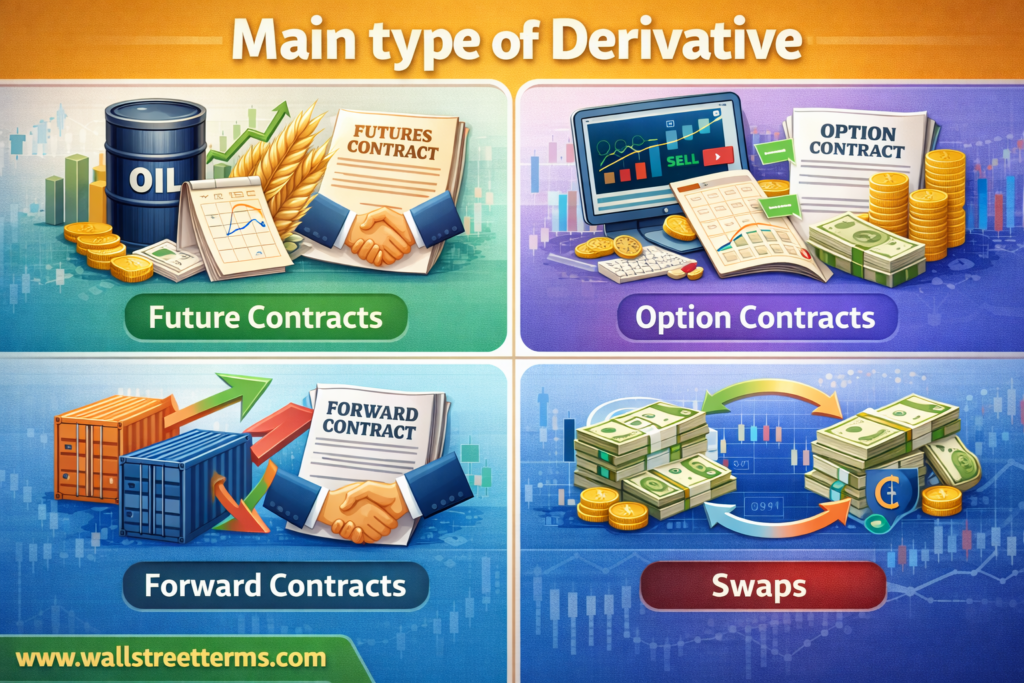
Main Types
There are several types of derivatives, but beginners should focus on four core categories.
1. Futures Contracts
A futures contract is an agreement to buy or sell an asset at a predetermined price on a specific future date.
Realistic example:
An airline company might use oil futures to lock in fuel prices. If oil prices rise later, the airline is protected because it already agreed on a lower price.
Futures are commonly used for commodities, indexes, and currencies.
2. Options Contracts
An option gives the buyer the right, but not the obligation, to buy or sell an asset at a specific price before a certain date.
- Call option: Right to buy
- Put option: Right to sell
Beginner example:
An investor buys a call option on Apple stock, expecting the price to rise. If Apple’s stock increases, the option becomes more valuable. If it doesn’t, the investor can let the option expire, losing only the premium paid.
3. Forwards Contracts
A forward contract is similar to a futures contract but is traded privately (over-the-counter) instead of on an exchange.
Example:
A U.S. company expecting to receive euros in six months may use a forward contract to lock in today’s exchange rate, reducing currency risk.
4. Swaps
A swap is a contract where two parties exchange cash flows based on different financial variables.
The most common type is an interest rate swap, where one party swaps a fixed interest rate for a variable one.
Swaps are widely used by banks and large institutions rather than individual investors.
How to used in Real Life
Derivatives aren’t just for Wall Street traders—they play a major role in the global economy.
Hedging example:
A farmer uses futures contracts to lock in a price for crops before harvest, protecting income from falling prices.
Speculation example:
A trader uses index options to bet on whether the broader market will rise or fall over the next month.
Portfolio management example:
Fund managers use derivatives to adjust exposure quickly without buying or selling large amounts of stock.
Benefits
When used responsibly, derivatives offer several advantages:
- Risk management and price stability
- Lower transaction costs compared to trading physical assets
- Access to markets that may otherwise be difficult to trade
- Flexibility in strategy design
These benefits are why derivatives are deeply integrated into global financial systems.
Risks and Misunderstandings
it also carry risks, especially for beginners.
Common risks include:
- Leverage risk: Small price changes can lead to large gains or losses
- Complexity: Some contracts are difficult to understand
- Counterparty risk: One side of the contract may fail to meet obligations
Many financial crises have involved misuse of derivatives—not because derivatives are inherently bad, but because they were poorly understood or improperly managed.
Are Derivatives Only for Professionals?
Not at all. While some derivatives are complex, many retail investors use basic options or index futures. However, beginners should start slow, focus on education, and avoid excessive leverage.
Understanding the purpose of a derivative is more important than mastering every technical detail.
Final Thoughts
A derivative is a financial contract whose value depends on an underlying asset, such as a stock, index, commodity, or currency. From futures and options to swaps and forwards, derivatives play a crucial role in managing risk and enabling market participation.
For beginners, the key takeaway is simple: derivatives are tools. When used wisely, they help protect against uncertainty and create opportunities. When misunderstood, they can amplify risk. Learning the basics gives you a strong foundation for navigating modern financial markets with confidence.
Related Posts
At-the-Money (ATM) Options Explained: What It Means When Strike Price Equals Market Price
If you’re learning options trading, you’ve likely come across the…
Options Contract: The Right (Not the Obligation) to Buy or Sell an Asset
Options Contract: The Right (Not the Obligation) to Buy or…

Forward Contract: A Customized OTC Agreement for a Future Trade
Forward Contract: A Customized OTC Agreement for a Future Trade…
One Reply to “Derivatives: A Financial Contract Whose Value Depends on an Underlying Asset”