Forward Contract: A Customized OTC Agreement for a Future Trade
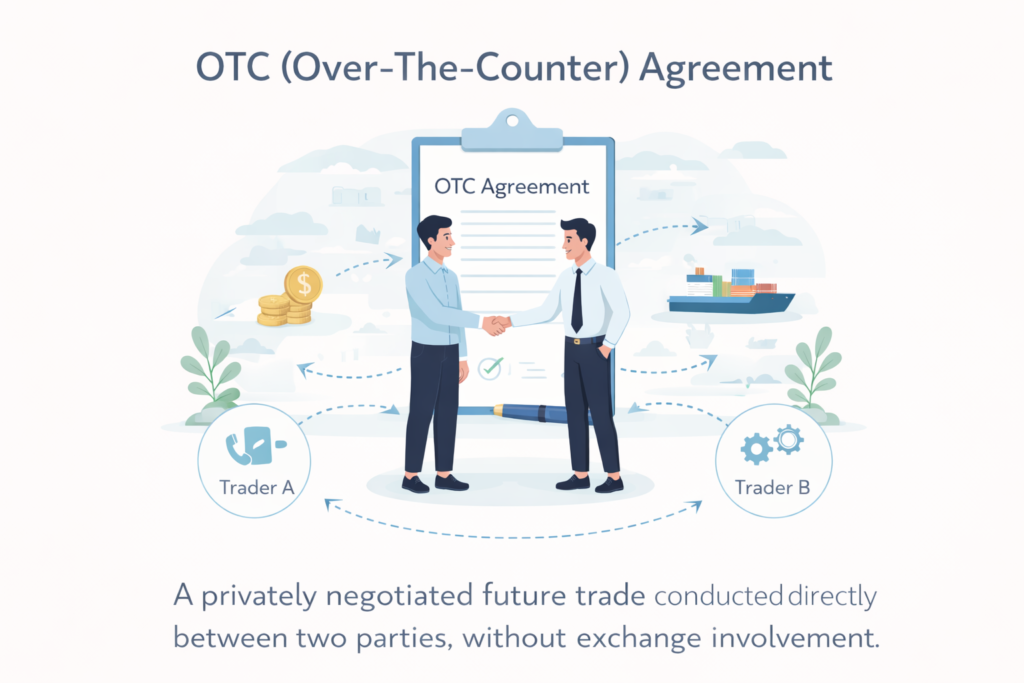
A forward contract is a private, customized agreement between two parties to buy or sell an asset at a specific future date for a price agreed upon today. Forward contracts are a type of derivative and are commonly used by businesses and institutions to manage risk related to prices, interest rates, or currencies. Unlike futures contracts, forwards are traded over the counter (OTC), meaning they are not bought or sold on a public exchange.
This beginner-friendly guide explains what forward contracts are, how they work, why they exist, and how they’re used in real-world financial situations.
What Is a Forward Contract?
A forward contract is a legally binding agreement where:
- One party agrees to buy
- The other party agrees to sell
- A specific asset
- At a fixed price
- On a future date
The key difference between forwards and other derivatives is customization. The two parties decide all contract details themselves, including quantity, price, and settlement date.
Simple example:
A U.S. company agrees today to buy euros in six months at a fixed exchange rate. Regardless of how currency markets move, the agreed price will apply on the settlement date.
Why Forward Contracts Exist
Forward contracts exist to reduce uncertainty. Prices for currencies, commodities, and interest rates can change unpredictably, creating risk for businesses.
Forward contracts are mainly used for:
- Hedging: Protecting against unfavorable price changes
- Planning: Improving budgeting and cash flow certainty
- Customization: Tailoring contracts to specific business needs
They are especially popular in international trade and corporate finance.
How Forward Contracts Work
A forward contract typically follows these steps:
- Agreement:
Two parties negotiate the terms privately. - Customization:
They decide the asset, price, quantity, and future settlement date. - Holding period:
No money usually changes hands at the start. - Settlement:
On the agreed date, the contract is settled—either through physical delivery or cash settlement.
Unlike exchange-traded products, forwards rely on trust and legal enforcement between the parties.
Common Underlying Assets in Forward Contracts
Forward contracts can be based on many types of assets, including:
- Currencies (most common)
- Commodities (oil, metals, agricultural products)
- Interest rates
- Financial instruments
Currency forward example:
A U.S. importer expects to pay a European supplier in euros. To avoid exchange rate risk, the importer enters a currency forward contract to lock in today’s EUR/USD rate.
Forward Contracts vs. Futures Contracts
Although forwards and futures sound similar, they are quite different.
| Feature | Forward Contract | Futures Contract |
| Trading venue | OTC (private) | Public exchange |
| Customization | Fully customizable | Standardized |
| Regulation | Limited | Highly regulated |
| Counterparty risk | Higher | Lower (clearinghouse) |
| Settlement | At maturity | Daily settlement |
Futures contracts trade on regulated exchanges such as the CME Group, while forward contracts remain private agreements.
Realistic Hedging Example
Real-world scenario:
A U.S.-based technology company expects to receive €5 million from European sales in nine months. If the euro weakens, the company would receive fewer dollars.
To protect against this risk, the company enters a forward contract to sell euros at a fixed exchange rate. If the euro falls, losses in the currency market are offset by gains from the forward contract.
This allows the business to plan revenue more confidently.
Who Uses Forward Contracts?
Forward contracts are commonly used by:
- Corporations involved in international trade
- Banks and financial institutions
- Exporters and importers
- Governments and large organizations
Individual retail investors rarely use forwards directly because they require credit arrangements and legal agreements.
Advantages of Forward Contracts
Forward contracts offer several benefits:
- Customization: Tailored to exact business needs
- Flexibility: No standardized contract size
- No upfront cost: Typically no initial payment
- Effective risk management: Locks in future prices
For businesses, this flexibility can be more valuable than the liquidity of exchange-traded products.
Risks of Forward Contracts
Despite their usefulness, forward contracts come with risks.
Key risks include:
- Counterparty risk: One party may fail to honor the contract
- Liquidity risk: Contracts are not easily sold or exited
- Opportunity cost: If prices move favorably, the fixed price still applies
Because forward contracts are private agreements, there is no clearinghouse to guarantee performance.
Settlement of Forward Contracts
Forward contracts can be settled in two ways:
- Physical delivery: The asset is exchanged
- Cash settlement: Only the price difference is paid
Most currency forwards settle in cash, making them practical for financial planning.
Forward Contracts in Today’s Financial System
Forward contracts play a critical role behind the scenes of global finance. While less visible than futures or options, they help companies manage risk quietly and efficiently.
Many forward contracts are negotiated through banks and financial institutions, which help manage credit risk and documentation.
Are Forward Contracts Suitable for Beginners?
Forward contracts are generally not designed for retail beginners. They are best suited for:
- Businesses with real exposure to price risk
- Institutions with credit relationships
- Professionals who understand OTC markets
Beginners usually start with exchange-traded instruments before exploring OTC derivatives.
Final Thoughts
A forward contract is a customized, over-the-counter agreement to buy or sell an asset at a fixed price on a future date. Its strength lies in flexibility and precision, making it a powerful tool for managing real-world financial risk—especially in currencies and commodities.
While forward contracts lack the transparency of exchange-traded products, they remain essential to global commerce. Understanding how they work gives you deeper insight into how businesses protect themselves from uncertainty and plan for the future with confidence.
Related Posts
Time Value in Options Explained: The Extra Value Based on Remaining Time
When you buy or sell an option, you’re not just…
Options Contract: The Right (Not the Obligation) to Buy or Sell an Asset
Options Contract: The Right (Not the Obligation) to Buy or…
Call Option: What It Means and How It Works
Call Option: What It Means (The Right to Buy an…