
What are Shares? A Beginner’s Guide With Simple Examples
A share represents a single unit of ownership in a company. When you buy a share, you own a small part of that business. In everyday language, the terms “share” and “stock” are often used interchangeably, but technically, a share is the individual unit, while stock refers to the overall ownership in a company.
In the United States, millions of people own shares through brokerage accounts, retirement plans like 401(k)s, and investment apps.
Understanding Shares in Simple Terms
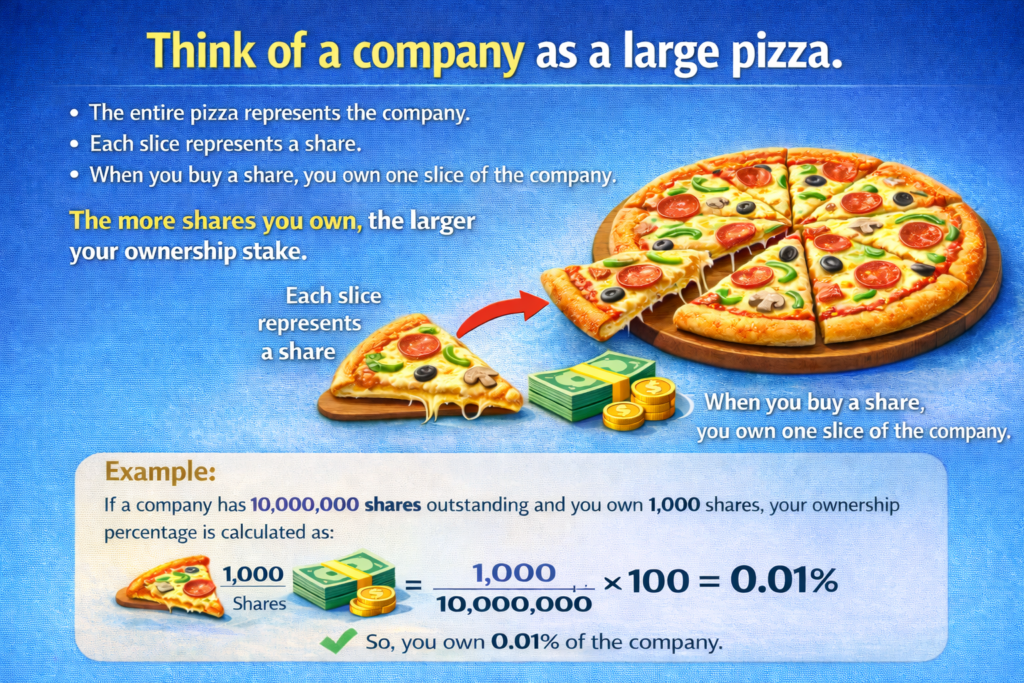
Think of a company as a large pizza.
- The entire pizza represents the company.
- Each slice represents a share.
- When you buy a share, you own one slice of the company.
The more shares you own, the larger your ownership stake.
Example:
If a company has 10 million shares outstanding and you own 1,000 shares, you own 0.01% of the company.
Why Companies Issue Shares
Companies issue shares to raise money without taking on debt. This money can be used to:
- Expand operations
- Develop new products
- Hire employees
- Enter new markets
When a company first sells its shares to the public, it’s called an Initial Public Offering (IPO). After the IPO, shares are traded between investors on stock exchanges.
Where Shares Are Traded in the US
In the United States, shares are bought and sold on regulated exchanges such as:
You can trade shares using online brokerages like:
- Fidelity
- Charles Schwab
- Robinhood
- E*TRADE
These platforms allow investors to buy even one share or sometimes fractional shares.
How Investors Make Money From Shares
There are two primary ways to earn returns from shares:
1️⃣ Capital Gains
This happens when you sell a share for more than you paid for it.
Example:
- You buy 1 share of Microsoft at $300
- You sell it later at $360
- Your gain = $60 (before taxes)
2️⃣ Dividends
Some companies distribute part of their profits to shareholders as dividends.
Example:
- A company pays a dividend of $1 per share annually
- If you own 100 shares, you earn $100 in dividend income
Dividend-paying shares are popular with income-focused investors, especially retirees.
Types of Shares in the US Market
Common Shares
Most investors own common shares. They usually provide:
- Voting rights
- Potential dividends
- Growth in value
Preferred Shares
Preferred shares typically offer:
- Fixed dividend payments
- Higher priority in dividend payouts
- Limited or no voting rights
Preferred shares behave more like income investments than growth investments.
Shares vs Stocks: What’s the Difference?
- Stock: Represents ownership in a company overall
- Share: A single unit of that ownership
Example:
You may say, “I own stock in Apple,” but technically, you own shares of Apple stock.
What Affects Share Prices?
Share prices change due to supply and demand in the market. Key factors include:
- Company earnings and revenue
- Economic conditions
- Interest rates
- Industry performance
- Investor expectations
- News and events
Example:
If a company reports strong earnings growth, investors may rush to buy its shares, pushing the price higher.

Risks of Owning Shares
While shares can offer high returns, they also carry risks:
- Share prices can be volatile
- Companies can perform poorly
- Market downturns can reduce share values
Example:
During market crashes, even strong companies can see their share prices fall temporarily.
This is why many US investors diversify by owning shares across multiple companies or through funds like ETFs.
Fractional Shares: Investing With Less Money
Many US brokers now allow investors to buy fractional shares, meaning you can invest with small amounts of money.
Example:
If a share costs $1,000, you can invest $50 and own 0.05 of a share.
This makes investing more accessible for beginners.
Why Shares Matter for Long-Term Investing
Historically, shares of US companies have delivered strong long-term returns. By reinvesting dividends and holding shares over time, investors benefit from compounding growth.
Example:
Owning shares in an S&P 500 index fund for decades has historically helped investors grow wealth and beat inflation.
Final Thoughts
A share is a basic building block of investing. Each share represents ownership, potential profits, and risk. Whether you’re buying one share or thousands, you’re participating in the growth of real businesses.
For beginners in the US, understanding shares is essential before investing. With proper education, patience, and a long-term approach, shares can play a powerful role in building financial security.
Related Posts
Bear Market: What It Means When the Stock Market Is Falling
If you’ve ever opened your investing app and seen your…

What Is an ETF? Complete Guide to Exchange-Traded Funds for Beginners (2026)
ETF (Exchange-Traded Fund): A Fund That Trades Like a Stock…
One Reply to “What are Shares? Understanding in 5 Minutes”