
Investor sentiment refers to the overall mood, attitude, and emotional tone of market participants. Are investors feeling optimistic and confident—or fearful and defensive? While fundamentals like earnings and interest rates matter, sentiment often drives short-term price movements, sometimes pushing markets to extremes.
For beginners in U.S. stock markets, investor sentiment indicators offer a way to understand how emotions are influencing prices. They don’t predict the future with certainty, but they help explain why markets sometimes rise or fall faster than logic alone would suggest.
This guide explains what investor sentiment is, why it matters, the most common sentiment indicators used in U.S. markets, and how to interpret them realistically.
What Is Investor Sentiment?
Investor sentiment is the collective emotional state of investors at a given time. It reflects:
- Confidence or fear
- Optimism or pessimism
- Willingness or reluctance to take risk
Sentiment answers questions like:
- Are investors eager to buy stocks?
- Are they rushing to sell?
- Are they complacent or anxious?
Importantly, sentiment is about how investors feel, not necessarily about economic reality.
Why Investor Sentiment Matters
Markets are forward-looking, but they are also emotional.
Investor sentiment matters because:
- Prices often move faster than fundamentals
- Emotions can cause overreaction
- Extremes in sentiment often appear near market turning points
In the short term, sentiment can dominate fundamentals. Over the long term, fundamentals tend to reassert themselves—but sentiment often determines the path prices take along the way.
Sentiment vs. Fundamentals: The Key Difference
- Fundamentals focus on value (earnings, cash flow, growth)
- Sentiment focuses on perception (fear, greed, confidence)
A stock can be:
- Fundamentally strong but fall due to negative sentiment
- Fundamentally weak but rise due to optimism and speculation
Sentiment indicators help explain why price and value sometimes diverge.
What Are Investor Sentiment Indicators?
Investor sentiment indicators are tools and data points designed to measure how bullish or bearish investors are. They don’t say whether the market should go up or down—they show how positioned and emotional investors already are.
Many sentiment indicators are used in a contrarian way, meaning:
- Extreme optimism can be a warning sign
- Extreme pessimism can signal opportunity
Major Categories of Sentiment Indicators
Sentiment indicators generally fall into four broad groups:
- Surveys
- Market-based indicators
- Volatility measures
- Positioning and flow data
Each captures a different angle of market psychology.
1. Investor Sentiment Surveys
AAII Investor Sentiment Survey
One of the most well-known surveys in the U.S. is conducted weekly by the American Association of Individual Investors (AAII).
It asks individual investors whether they feel:
- Bullish
- Bearish
- Neutral
When bullish readings are extremely high, optimism may be excessive. When bearish readings spike, fear may be elevated.
Surveys are useful because they capture what investors say they believe, though not always what they do.
Professional and Institutional Surveys
Some surveys focus on professional money managers and advisors. These tend to move more slowly than retail sentiment but can still reach extremes during major market events.
2. Market-Based Sentiment Indicators
Market-based indicators infer sentiment from actual trading behavior rather than opinions.
Put/Call Ratio
This ratio compares:
- Put options (bets on decline)
- Call options (bets on rise)
High put/call ratios suggest fear and downside protection. Low ratios suggest optimism or complacency.
Because options involve real money, this indicator reflects emotional positioning, not just sentiment expressed in words.
Advance/Decline Data
This tracks how many stocks are rising versus falling on a given day.
- Broad participation = healthier sentiment
- Narrow leadership = more fragile sentiment
Sharp imbalances can signal emotional extremes.
3. Volatility as a Sentiment Gauge
Market volatility often rises when fear increases.
Although volatility itself is not an emotion, it reflects how investors react to uncertainty.
- Low volatility often aligns with confidence or complacency
- High volatility often aligns with fear or panic
Volatility spikes are common during market stress on major exchanges like the New York Stock Exchange, where sudden selling pressure can spread rapidly.
4. Fund Flows and Positioning Data
Equity Fund Flows
Tracking money flowing into or out of stock funds provides insight into sentiment.
- Large inflows suggest optimism
- Large outflows suggest fear or risk aversion
When investors rush into equities after long rallies, sentiment may be stretched.
Cash Levels
High cash levels among investors often indicate caution or fear. Low cash levels suggest confidence—or overconfidence.
Positioning data shows how committed investors already are, which affects future buying or selling power.
Sentiment Indicators in U.S. Stock Markets
Investor sentiment indicators are widely followed in markets trading on the NASDAQ and NYSE, especially during:
- Bull market peaks
- Market corrections
- Economic uncertainty
They help explain why stocks can rise or fall sharply even when news appears modest.
How to Interpret Sentiment Indicators (Beginner-Friendly)
Sentiment indicators are not buy or sell signals by themselves. They are context tools.
General Interpretation Framework
- Neutral sentiment → Market behaving normally
- Extreme optimism → Risk of disappointment increases
- Extreme pessimism → Risk-reward may improve
Think of sentiment as measuring crowd behavior, not predicting exact outcomes.
Sentiment Extremes and Market Turning Points
Historically:
- Major market bottoms often occur when fear is widespread
- Major market tops often occur when optimism feels unquestioned
This does not mean sentiment extremes cause reversals—but they often appear near emotional exhaustion points.
A Realistic Example: Fear During a Market Pullback
Imagine:
- The market drops 15% over several months
- Headlines turn negative
- Bearish sentiment spikes
- Volatility rises sharply
This combination suggests fear may be elevated. While prices can still fall further, long-term investors often begin paying closer attention during these periods.
A Realistic Example: Euphoria After a Long Rally
Now imagine:
- Markets rise steadily for years
- Volatility remains very low
- Bullish sentiment dominates surveys
- Cash levels fall as investors stay fully invested
This environment often reflects confidence or complacency, where risk may be underappreciated.
Common Beginner Mistakes With Sentiment Indicators
Many new investors misuse sentiment data.
Mistake 1: Treating Sentiment as a Timing Tool
Sentiment can stay extreme longer than expected.
Mistake 2: Using One Indicator in Isolation
Sentiment works best when combined with valuation, trend, and fundamentals.
Mistake 3: Confusing Short-Term Mood With Long-Term Outlook
Sentiment is emotional and temporary. Businesses and economies evolve more slowly.
How Professionals Use Sentiment Indicators
Experienced investors use sentiment indicators to:
- Adjust risk exposure gradually
- Avoid emotional extremes
- Frame expectations realistically
They don’t try to predict exact tops or bottoms. Instead, they recognize when crowd psychology may be stretched.
How Beginners Can Use Sentiment Wisely
You don’t need to trade frequently to benefit from sentiment awareness.
Practical uses include:
- Avoiding panic during fearful markets
- Avoiding overconfidence during euphoric markets
- Staying disciplined when emotions run high
- Reviewing portfolio risk during sentiment extremes
Sentiment helps answer: “Am I thinking clearly—or reacting emotionally like everyone else?”
Sentiment vs. Market Efficiency
Even in highly regulated markets overseen by the U.S. Securities and Exchange Commission (SEC), sentiment plays a powerful role.
Regulation ensures fairness and transparency—but it cannot eliminate human emotion. Markets remain a blend of data and psychology.
A Simple Sentiment Self-Check
Before making a decision, ask:
- Does this decision feel urgent because of headlines?
- Am I reacting to fear or excitement?
- What does sentiment data suggest about crowd behavior?
If emotions are elevated, slowing down is often the smartest move.
Final Takeaway
Investor sentiment indicators help measure the emotional temperature of the market—whether investors are fearful, confident, or complacent. While they don’t replace fundamentals or long-term strategy, they provide valuable context for understanding price movements and risk.
For beginners in U.S. stock markets, sentiment awareness is a powerful skill. It helps you avoid chasing hype, panicking during downturns, and making decisions driven by emotion rather than logic.
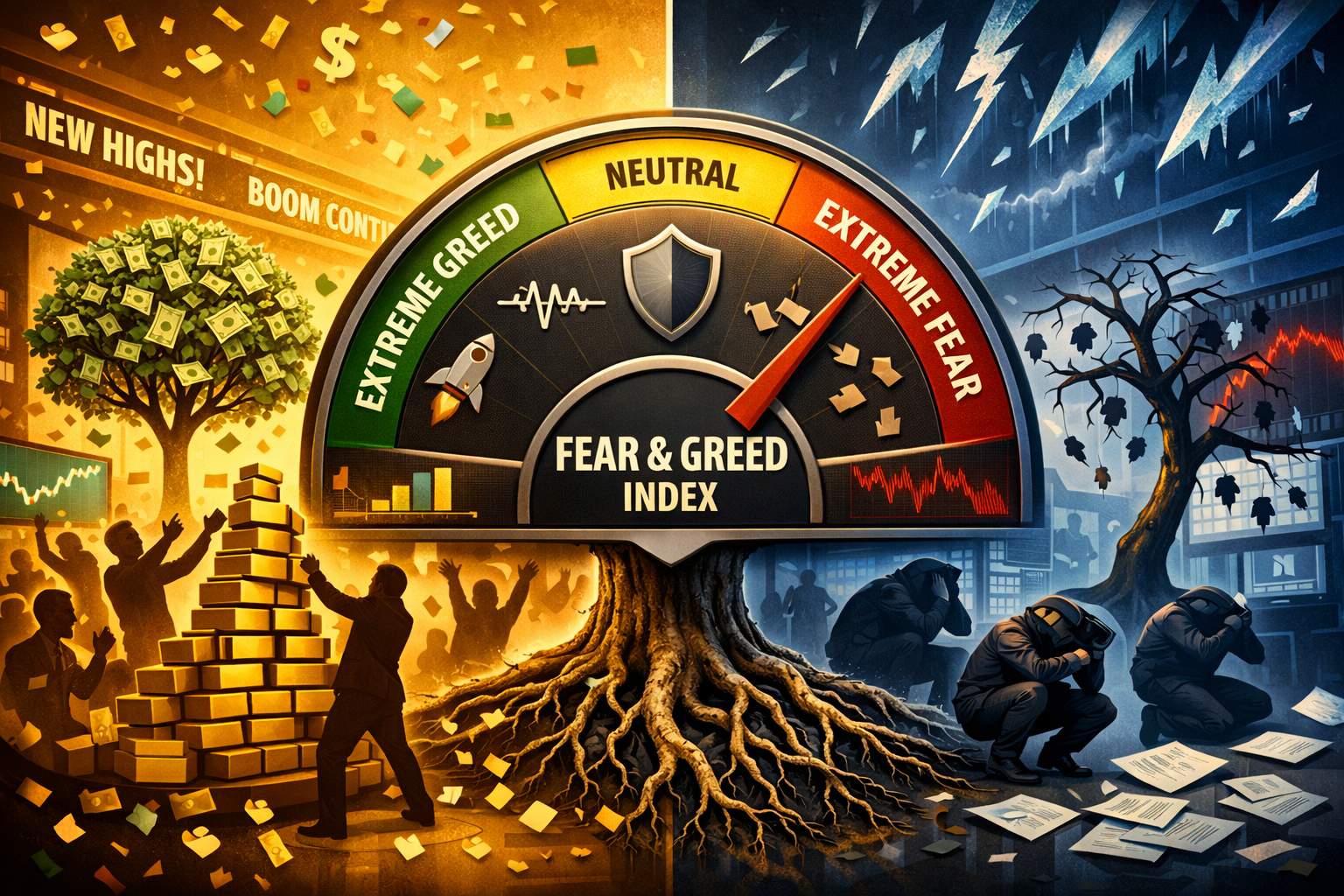
Markets will always swing between fear and greed.
The goal isn’t to escape emotion—but to recognize it, respect it, and refuse to let it take control.
Investor Sentiment Indicators: Frequently Asked Questions
Investor sentiment indicators are tools used to measure the overall mood of market participants. They show whether investors are feeling bullish (optimistic) or bearish (fearful), helping traders and long-term investors understand market psychology.
Investor sentiment is important because market prices are heavily influenced by emotions like fear and greed. Extreme optimism can signal potential market tops, while extreme fear may indicate possible market bottoms.
Popular sentiment indicators include the VIX (Volatility Index), the Fear and Greed Index, the Put/Call Ratio, and the AAII Investor Sentiment Survey. These tools measure volatility, options positioning, and investor expectations.
The VIX measures expected volatility in the S&P 500. A high VIX typically signals fear in the market, while a low VIX often indicates investor confidence or complacency.
Investor sentiment does not guarantee future price movements, but extreme sentiment levels can act as contrarian signals. High optimism may suggest overvaluation, while extreme fear may present buying opportunities.
Related Posts
What Is Panic Selling? How Fear Triggers Market Crashes
What Is Panic Selling? How Fear Triggers Market Crashes Financial…
Emotional Investing: How Feelings Hurt Long-Term Returns
Emotional investing happens when you make money decisions based on…
Fear and Greed Index Explained: How Emotions Control the Market
Fear and Greed Index Explained: How Emotions Control the Market…